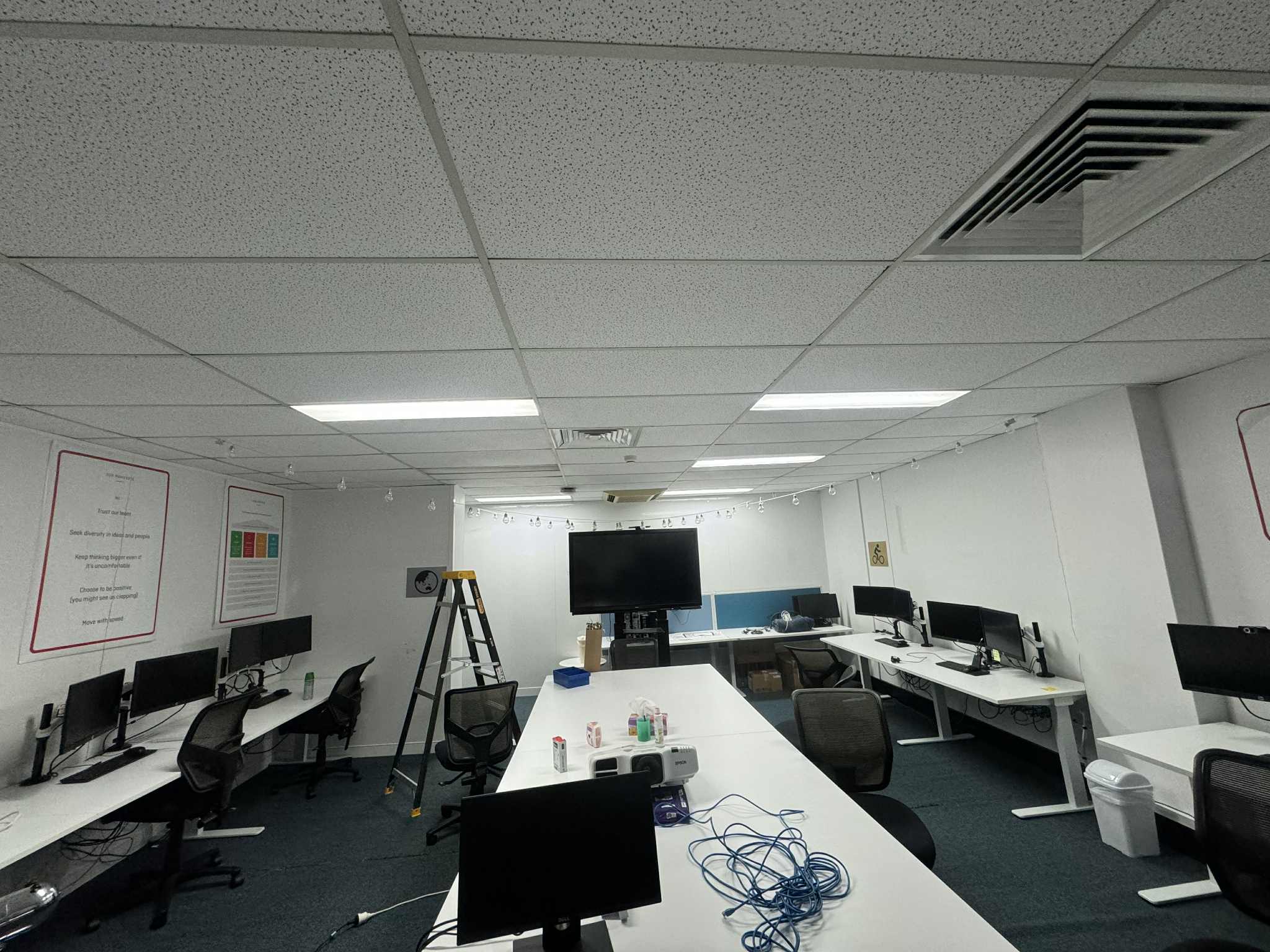
Why Replace Legacy Fluorescents with LED?
- Lower energy use: Quality LED panels often use 40–60% less power than twin 36W fluorescent troffers (once ballast losses are included).
- Long service life: 50,000+ hour LED lifespans reduce call‑outs and disruption for lamp changes.
- Better light quality: Higher colour rendering (CRI), consistent colour temperature (often 4000K neutral white for offices) and reduced flicker mitigate eye strain.
- Reduced heat load: Less waste heat can marginally assist HVAC efficiency in conditioned spaces.
- Compliance & safety: A refit lets you address emergency lighting (AS/NZS 2293) & task lighting levels (AS/NZS 1680) at the same time.
Example Energy & Cost Savings (Illustrative)
Scenario: 50 x ageing recessed fluorescent troffers (2 × 36W tubes each). Including ballast losses, each fitting draws ≈80W. Proposed replacement: 50 x 30W LED edge‑lit panels with similar or better lumen output.
- Existing load: 50 × 80W = 4.0 kW
- LED load: 50 × 30W = 1.5 kW
- Operating profile: 10 hours/day, 5 days/week ≈ 260 working days/year
- Annual kWh (fluorescent): 4.0 kW × 10 × 260 = 10,400 kWh
- Annual kWh (LED): 1.5 kW × 10 × 260 = 3,900 kWh
- Estimated savings: 6,500 kWh/year
At an indicative blended electricity rate of $0.30/kWh: 6,500 × $0.30 ≈ $1,950/year saved on lighting energy alone (ex GST). Additional indirect savings (reduced re-lamping labour, less HVAC load) are not included.
Simple Payback (High-Level)
If supply & install of quality commercial LED panels averages $180 per fitting (varies with access, controls, emergency requirements), project cost ≈ $9,000. With ~$1,950/year energy savings:
- Estimated simple payback: ≈ 4.6 years
- Effective life horizon: 50,000 hours at 2,600 hours/year ≈ 19+ years (light depreciation & actual usage may shorten this)
- Real-world payback often improves when: adding occupancy/daylight sensors, leveraging tariff changes, or avoiding frequent tube & starter replacements.
Note: Actual pricing and payback depend on product specification, ceiling type, access equipment, control strategy, emergency fittings and any power factor or wiring corrections performed during the upgrade.
Lighting Design & Compliance Considerations
- Illuminance (lux): Open-plan offices commonly target 320–400 lux on the working plane (refer to AS/NZS 1680.1 & task‑specific parts).
- Uniformity: Even distribution reduces fatigue; quality panels and layout spacing matter.
- UGR / Glare: Low‑glare diffusers & correct mounting height minimise discomfort.
- Colour temperature: 4000K neutral white is a popular balance for alertness and comfort; reception or breakout zones may differ.
- Emergency & exit lighting: Ensure AS/NZS 2293 testing & logbook updates when fittings are altered.
Controls for Additional Savings
- Occupancy / vacancy sensors: Automatically switch or dim unused meeting rooms & store areas.
- Daylight harvesting: Sensor‑based dimming along window banks cuts daytime consumption.
- Time scheduling: Prevent after‑hours wastage—integrate with BMS where available.
- Task tuning: Set default light levels lower than maximum where full output isn’t required.
Practical Upgrade Tips
- Audit existing circuit loading & protective devices before adding drivers or rebalancing phases.
- Select branded drivers & panels with documented lumen maintenance (L70 / L80) and warranty support.
- Label circuits & update as‑built drawings for future maintenance.
- Coordinate ceiling access (e.g., after hours) to minimise disruption to staff.
Sample Rollout Sequence
- Site survey: count fittings, measure lux, note ceiling type & emergency locations.
- Design & product selection: panel size, lumen package, CCT, CRI, controls.
- Quote & ROI summary: energy model + installation scope.
- Staged installation after hours to limit downtime.
- Commission controls (sensors, dimming) & verify emergency lighting.
- Post‑upgrade verification: spot lux checks & client handover pack.
Environmental & ESG Benefits
Reduced kWh lowers Scope 2 emissions (subject to grid factors) and supports sustainability reporting. Longer life also means fewer materials entering waste streams.
Planning more than lighting? Read our guide to choosing a commercial electrician for office buildings in Sydney, covering fitouts, compliance testing and maintenance.
Ready to Assess Your Office?
Request an LED Upgrade Assessment
This article is general information only. Savings & payback examples are indicative; always obtain a tailored assessment by a licensed electrician. Standards references (AS/NZS 1680, 2293) are summarised only—consult the full documents for detailed requirements.