Sydney summers are getting longer, hotter and more humid, and every December the same thing happens: the heat arrives, everyone remembers they wanted a ceiling fan in the bedroom, and electricians' diaries fill up. If you've been searching for ceiling fan installation near me, the best time to book is now, before the first heatwave.
PrimeTime Electrical & Communications is a licensed electrical business based in Penshurst, with 50+ Google reviews from local homeowners. This guide covers why ceiling fans are worth it, how they compare with air conditioning, how to pick the right fan for each room, and what a proper installation involves.
Where can I get a ceiling fan installed near me in Sydney? Use a licensed electrician, since installing a ceiling fan is electrical work that NSW law requires a licensed electrician to do. PrimeTime Electrical installs indoor and outdoor ceiling fans across the Eastern Suburbs, Sutherland Shire and St George, with upfront quotes and a Certificate of Compliance for the electrical work. Call 0416 049 923.
Why Ceiling Fans Are Worth It for a Sydney Summer
A ceiling fan doesn't change the temperature of a room. What it does is move air across your skin, which helps sweat evaporate and makes you feel several degrees cooler. In Sydney's humid summers, that airflow often makes the difference between a sticky, sleepless night and a comfortable one.
Very Low Running Costs
A ceiling fan uses a small fraction of the power an air conditioner draws, so you can run it all night without worrying about the next power bill.
Better Sleep
A gentle, quiet breeze in the bedroom is one of the simplest ways to sleep better through humid nights, with no dry air or noisy outdoor unit.
Makes Aircon Go Further
Run a fan alongside your air conditioner and you can set the thermostat a couple of degrees higher while feeling just as cool, which cuts aircon running costs.
Useful All Year
Most modern fans have a reverse mode that gently pushes warm air back down from the ceiling in winter, so the fan keeps working after summer ends.
Ceiling Fan vs Air Conditioning: Which Do You Need?
It's one of the most common questions we get before summer, and the honest answer is that they do different jobs. Many Sydney homes end up with both: aircon in the main living area, and ceiling fans in the bedrooms and outdoor spaces.
| Ceiling Fan | Air Conditioning | |
|---|---|---|
| How it cools | Moves air so you feel cooler | Lowers the actual room temperature |
| Power use | Typically tens of watts | Typically a thousand watts or more |
| Running cost | Very low | Moderate to high in a heatwave |
| Noise | Near-silent (especially DC motors) | Indoor and outdoor unit noise |
| Best for | Bedrooms, studies, patios, humid nights | Extreme heat days, large living areas |
| Winter use | Reverse mode circulates warm air | Reverse-cycle units provide heating |
The best of both
For most families, fans in every bedroom and aircon in the living area gives the best comfort for the lowest running cost. If you're adding several fans, we'll check that your switchboard and circuits can handle the extra load, and we can install them all in one visit.
How to Choose the Right Ceiling Fan
DC motor or AC motor?
DC motor fans are the popular choice now. They use noticeably less power, run almost silently, offer more speed settings and usually come with a remote. AC motor fans cost less upfront and are simple and durable, which makes them a solid choice for rooms where the fan only runs occasionally. For bedrooms where the fan runs all night, DC is usually worth it.
Picking the right size for each room
Fan size is measured by blade sweep, the full diameter the blades cover. A fan that's too small for the room won't move enough air, and an oversized one can feel overwhelming in a small bedroom.
| Room | Typical Blade Sweep | What to Look For |
|---|---|---|
| Small bedroom / study | Around 36–48 inches | Quiet DC motor, low lowest-speed setting |
| Main bedroom | Around 48–52 inches | DC motor, remote control, optional light |
| Living / open-plan | Around 52–60 inches (or two fans) | Strong airflow, fan + light combo |
| Patio / alfresco | 52 inches and up | Outdoor or damp-location rating |
| High or raked ceilings | Sized to the room | Extension rod or angled-ceiling kit |
Fan with a light, or fan only?
If the fan is going where your main ceiling light currently is, a fan with a built-in LED light keeps the room properly lit. Choose a warm-white light for bedrooms and a neutral white for living areas and kitchens.
Coastal homes need the right materials
In beachside suburbs like Bondi, Coogee, Cronulla and Sans Souci, salt air corrodes standard metal finishes quickly, especially on patios. Choose fans rated for outdoor or coastal use, with materials that won't rust within a few summers.
Recent Ceiling Fan Installations
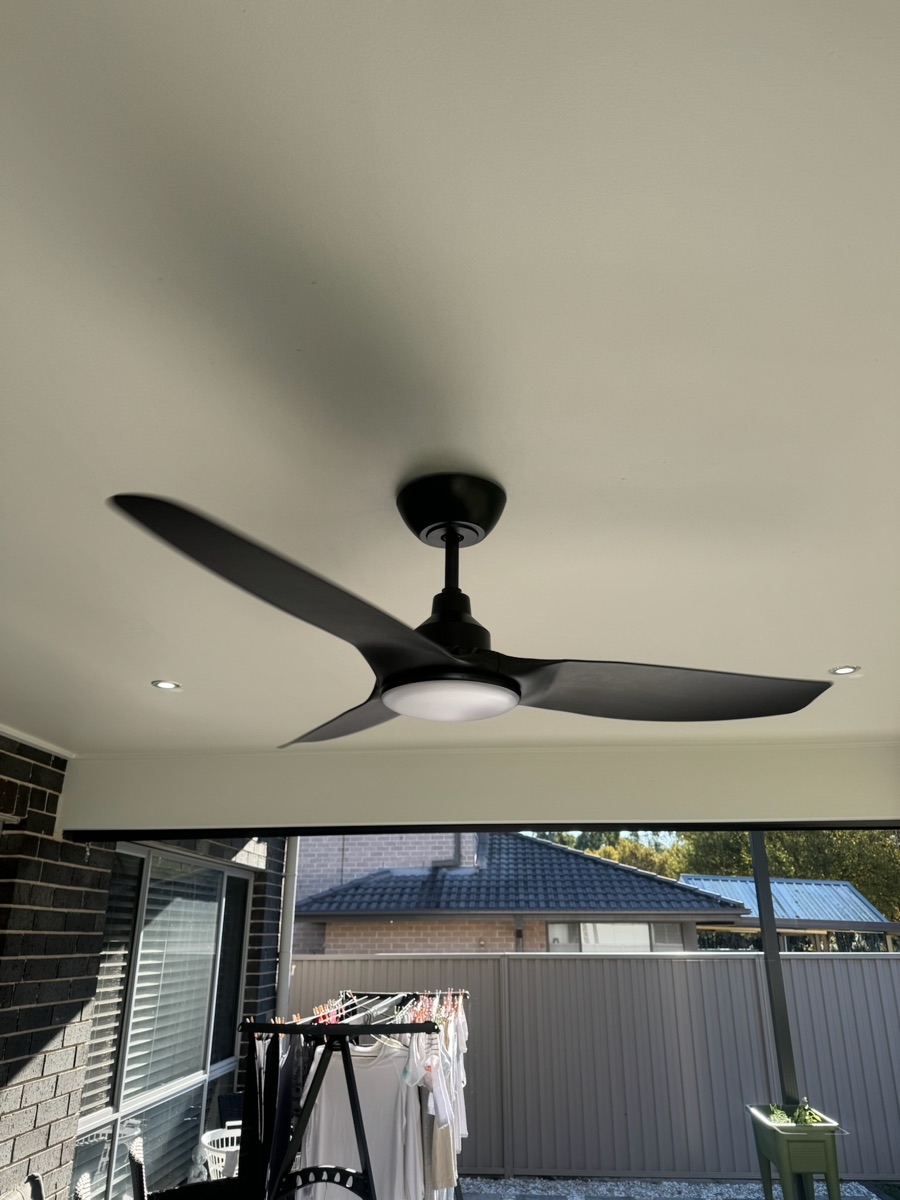
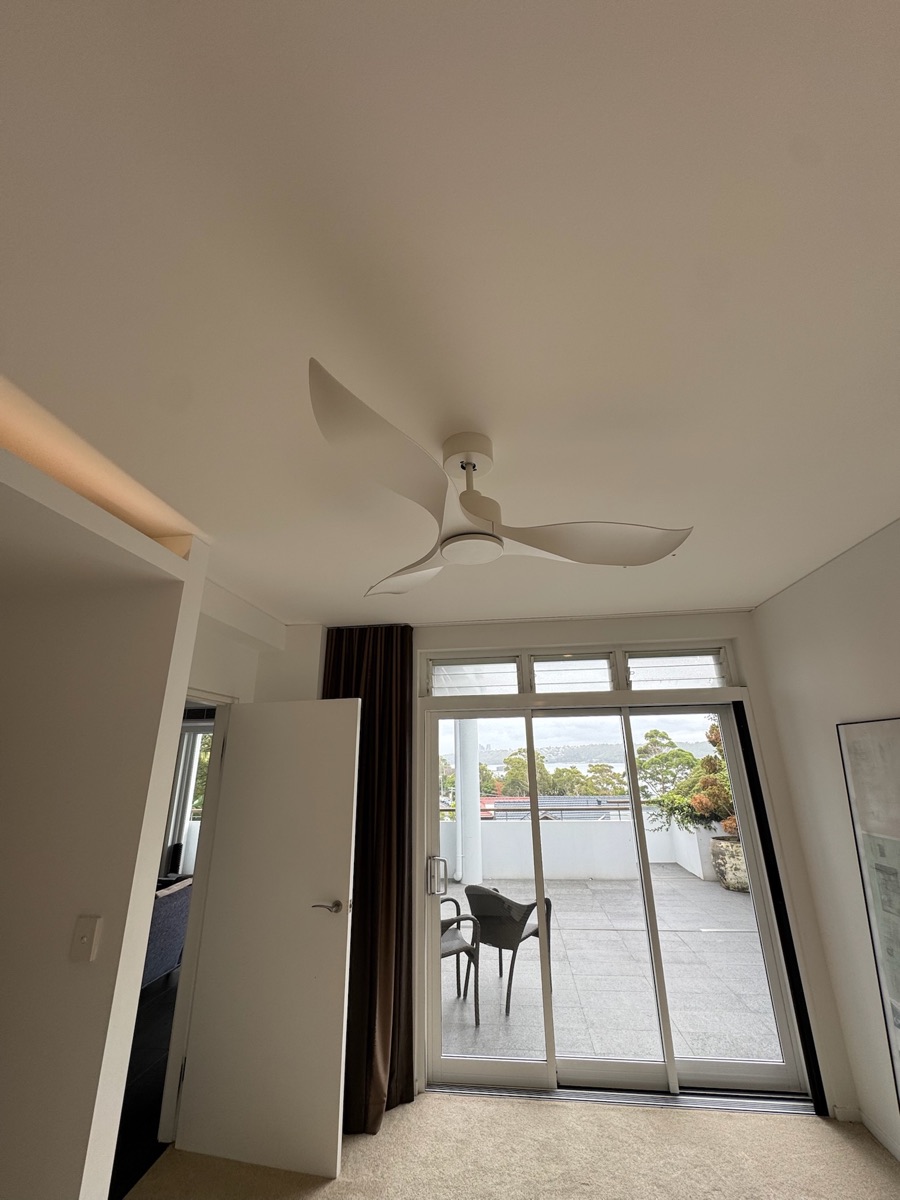
Two recent jobs that show how the right fan suits the space: a dark fan with a built-in light for a covered outdoor area, and a white fan that disappears into a bright bedroom ceiling.
Signs It's Time to Install or Replace a Ceiling Fan
Book in before summer if:
- Bedrooms are too hot to sleep in
- Your aircon runs all night in summer
- Your existing fan wobbles or clicks
- The fan hums, buzzes or runs slowly
- Your outdoor area is unusable on hot days
- You're renovating or repainting ceilings
- Fan controls are worn or unreliable
- Your old fan's light doesn't work
A wobbling, noisy or sparking fan isn't only annoying. It can mean a loose mounting or a wiring fault, which should be looked at by a licensed electrician rather than left until it fails.
What a Professional Ceiling Fan Installation Involves
A ceiling fan is heavy, spins for hours and moves constantly, so how it's mounted and wired matters. Here's how we approach every fan installation.
Check the Ceiling & Wiring
We confirm the ceiling structure can safely support the fan's weight and movement, check the existing wiring, and identify the best position for airflow and clearance.
Secure Mounting
The fan bracket is fixed to a solid structural point, with extra bracing added where needed. This is what prevents wobble and keeps the fan safe for years.
Compliant Wiring & Controls
The fan is wired to AS/NZS 3000 standards, along with a wall control, remote or smart controller if you want one.
Balance & Test
We test every speed, the reverse function and any light, and balance the blades so the fan runs smoothly and quietly.
Clean Up & Certify
We leave the room tidy, show you how to use the controls, and provide a Certificate of Compliance for the electrical work.
Can I install a ceiling fan myself?
No. In NSW, connecting a ceiling fan to your home's wiring is electrical work that must be done by a licensed electrician. DIY installation can void your home insurance and the fan's warranty, and a poorly mounted fan is a real safety hazard. Installing a new fan where there's no existing wiring may also need new cabling, a new switch or extra ceiling support.
Sydney homeowners rate us for turning up on time, clear communication and neat, tidy work.
Ceiling Fan Installation Areas Near You
Based in Penshurst, we install ceiling fans across Sydney's east and south. If your suburb is listed below, we're local to you.
🌊 Eastern Suburbs
Ceiling fan installation near you across Sydney's east:
🌳 Sutherland Shire
Ceiling fan electricians throughout the Shire:
🏡 St George
Local ceiling fan installation, close to our Penshurst base:
We also install ceiling fans across the Inner West and Northern Sydney. See our Sydney ceiling fan installation guide, our ceiling and exhaust fan installation service, or all service areas.
How Much Does Ceiling Fan Installation Cost?
The cost depends on the job. Swapping an old fan for a new one in the same spot is a different job from installing a fan where there's no existing wiring, putting fans in several rooms, or working with high or raked ceilings. Wall controls, outdoor locations and extra ceiling bracing also affect the price.
Rather than publish a figure that may not match your home, we'll give you a clear, upfront price for the whole job before any work starts. If you're installing fans in several rooms, ask about doing them in one visit.
Contact us for a free, no-obligation ceiling fan installation quote.
Ceiling Fan Installation FAQs
Can I install a ceiling fan myself in NSW?
No. In NSW, connecting a ceiling fan to your home's wiring is electrical work that must be done by a licensed electrician. Unlicensed work can void your home insurance and the fan's warranty, and it's a genuine fire and shock risk.
How long does a ceiling fan installation take?
Replacing an existing fan or light with a ceiling fan is usually quick, often under two hours per fan. A new location that needs fresh cabling, a new wall control or extra ceiling support takes longer. We give you a clear timeframe with your quote.
Can a ceiling fan replace an existing light fitting?
Often, yes. Many fans can go where a ceiling light currently is, and a fan with a built-in light keeps the room lit. We check the ceiling can support the fan's weight and movement, and add proper bracing if it can't.
Is a ceiling fan cheaper to run than air conditioning?
Yes, by a wide margin. A ceiling fan typically draws tens of watts, while an air conditioner in cooling mode draws a thousand watts or more. Fans don't lower the room temperature, but the airflow makes you feel noticeably cooler, and using a fan alongside aircon lets you set the thermostat higher.
Do you install ceiling fans outdoors?
Yes. Patios, alfresco areas and covered decks need a fan rated for outdoor or damp locations, installed on a suitable circuit. This matters particularly in coastal suburbs where salt air corrodes standard fans.
How much does ceiling fan installation cost?
It depends on whether you're replacing an existing fan or light, how many fans you're installing, ceiling height and access, and whether new cabling or a wall control is needed. Call us on 0416 049 923 for a clear, upfront quote.
Beat the Summer Rush
Book your ceiling fan installation before the first heatwave. Licensed, local electricians with 50+ Google reviews across the Eastern Suburbs, Sutherland Shire and St George.